



Short answer: from your mid-twenties, your body gradually makes less collagen, the protein that helps keep your skin firm. Your skin also renews itself more slowly and often becomes drier. After thirty, you may start to notice it: fine lines, skin that feels tight more easily, make-up that sits differently. That’s normal. What makes the biggest difference? Daily sunscreen, good sleep, enough protein and vitamin C, and giving your skin the building blocks it needs every day.
At some point after thirty, you suddenly spot it. A line on your forehead that’s still there in the evening. Skin that feels tight after a shower. Foundation settling into fine lines. Or hair that seems thinner and nails that break more easily. There’s nothing wrong with you, but something is changing. In this article, we’ll explain what’s happening, what you can do and what you can — and can’t — expect from a supplement.
At a glance
- From your mid-twenties, your body makes a little less collagen each year.
- Your skin renews itself more slowly, produces less oil and holds on to less moisture.
- Sun exposure is the biggest external factor. That’s why sunscreen is your best investment.
- Protein, vitamin C and zinc are important building blocks for your skin, hair and nails.
- For a collagen supplement to have an effect, you need to take it every day for months.
What changes in your skin
Your skin has layers. On top is the epidermis, the layer you can see and feel. Beneath it is the dermis: a strong network that gives your skin its shape and springiness. That network is made mostly of collagen.
Collagen is a protein. It’s the most abundant protein in your body, found not just in your skin but also in your bones, tendons and blood vessels. In your skin, it’s like the beams of a house. The stronger the beams, the firmer the skin.
When you’re young, your body keeps making new collagen. But from around the age of twenty-five, that gradually slows down. You’ll often hear a figure of around one per cent a year. You won’t notice it at first. But over ten or fifteen years, it adds up.
Other things change, too:
- Your skin renews itself more slowly. In younger people, the outermost layer is replaced in about four weeks. Later, it can take six weeks or longer. This can make your skin look duller.
- You produce less oil. Your skin’s natural oils help keep it supple. Less oil often means drier skin that feels tight more easily.
- Your skin holds on to less moisture. Your body also makes less hyaluronic acid, a substance that holds water in your skin.
- There’s less elastin. This is another protein that helps your skin spring back. Without as much of it, a line from smiling may linger longer.
What about your hair and nails?
It’s not just your skin. Many women notice changes in their hair and nails around this age, too. Hair may feel thinner, or you might find more of it in your brush. Nails can become more brittle, breaking or splitting more easily.
There are different reasons for this. Hormones play a part, for example after pregnancy or around menopause. Stress, too little sleep and a lack of certain nutrients can also show up in your hair and nails. And like your skin, your hair needs time: it grows about a centimetre a month. So changes you make today won’t show up in the lengths for months.
Hormones and menopause
Oestrogen, one of the female hormones, helps your skin retain collagen and moisture. While your cycle is regular, you may not notice much. But oestrogen levels fall in the years around menopause. This often starts in your forties, sometimes earlier.
That’s when collagen loss speeds up. Many women notice their skin becoming drier and thinner over a relatively short time. Spots can even return as the balance between your hormones changes. Read more in Hormonal spots: how your hormones affect your skin.

What can speed it up
You can’t change your age. But how quickly your skin changes depends a lot on what it’s exposed to.
- Sun. This is by far the biggest factor. UV light breaks down collagen and elastin in your skin. Just compare the skin on your face with the skin on your stomach or the inside of your arm.
- Smoking. Smoking narrows the tiny blood vessels in your skin, so it gets less oxygen and fewer nutrients.
- Sleep. Your skin repairs itself at night. Consistently getting too little sleep often shows up as dull, tired-looking skin.
- External dryness. Cold, wind, central heating and very hot showers dry out your skin.
What you can do
The good news? The things that help most are simple and don’t cost much.
- Apply sunscreen every morning. SPF 30 or higher, even when it’s cloudy. If you do just one thing, make it this.
- Use a good moisturiser. A moisturiser helps your skin hold on to water. If your skin is drier, choose a slightly richer one.
- Shower in warm water, not hot. Afterwards, pat your face dry instead of rubbing it.
- Eat enough protein. Collagen is a protein. Your body makes it from the amino acids you eat, found in foods such as fish, meat, eggs, dairy, beans and nuts.
- Eat fruit and vegetables every day. They’re sources of vitamin C. Think peppers, kiwi fruit, oranges and broccoli.
- Get enough sleep. Seven to nine hours a night is a good goal for most adults.
Skincare products containing ingredients such as retinol or vitamin C can also be a useful addition. Start slowly, with one product at a time. If you’re pregnant or planning to become pregnant, ask for advice first, as retinol isn’t suitable then.
Why building blocks from within matter
Creams mainly work on the top layer of your skin. But collagen is made in the dermis, deeper down, where most creams can’t reach. Your skin gets what it needs there through your blood, from what you eat and drink.
A few building blocks are especially important:
- Vitamin C. Vitamin C contributes to normal collagen formation for the normal function of skin. Without vitamin C, your body can’t make collagen.
- Zinc. Zinc contributes to the maintenance of normal hair, nails and skin.
- Amino acids. Collagen contains a lot of certain amino acids, including glycine, proline and hydroxyproline. Your body uses these to make new collagen of its own.
When you take collagen, your body first digests it into smaller pieces. It uses these as building blocks where they’re needed. Find out more in Taking collagen: how does it work and what should you look for?
It was mainly those lines on my forehead... all my foundation settled in them. My skin feels less dry now and my make-up sits better. The lines are still there, but I notice them less.
Wendy · 11 August 2026
What you can and can’t expect
We want to be honest, because you’ve probably heard plenty of promises already. A supplement won’t make you look ten years younger, and lines won’t disappear. You shouldn’t expect that from any powder or drink.
What you can expect is to give your skin the building blocks it needs every day, and to keep it up. Wendy puts it well: the lines are still there, but her skin feels less dry and her make-up sits better. That kind of difference is real, and it makes sense given how your skin works.
And as with anything to do with your skin, it takes time. Your skin renews itself over weeks; your hair grows over months. So judge it after 90 days, not two weeks.
Where Glow+ fits in
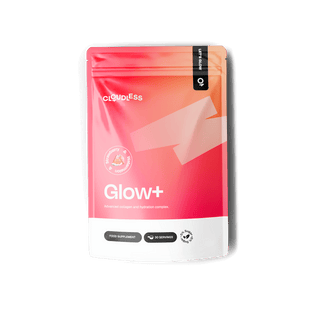
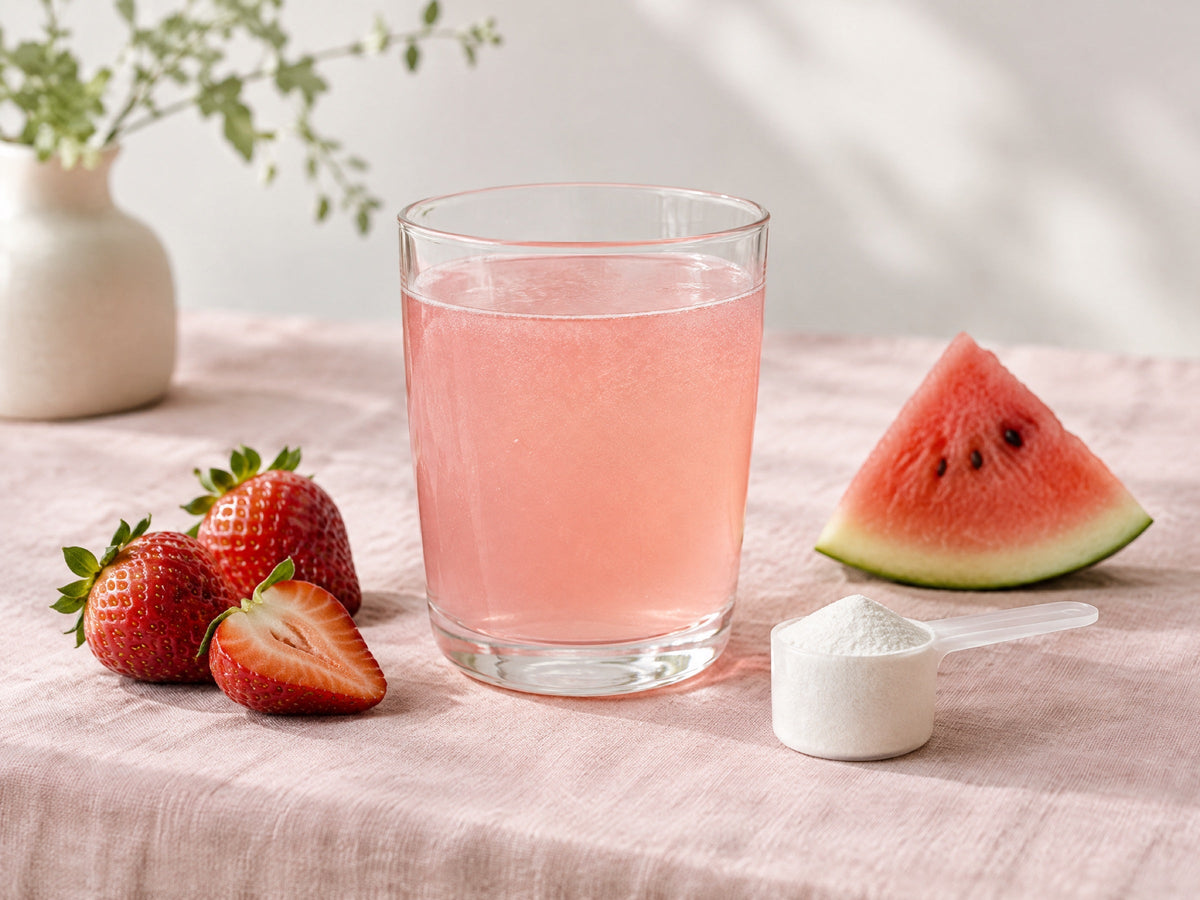
Glow+ is our collagen drink for adults. It’s made for this stage, when your skin, hair and nails could do with a little more than they used to. One scoop contains:
- Collagen
- 8,000 mg hydrolysed type I collagen, from bovine sources
- Vitamin C
- 500 mg, to help your body make collagen
- Zinc
- 4.5 mg, for skin, hair and nails
- Plus
- 1,500 mg MSM, 500 mg gotu kola and 100 mg hyaluronic acid
Mix one scoop into 250 ml of water. It has a Strawberry Watermelon flavour, so it feels more like a drink than a supplement. One pouch lasts 30 days. Every batch is tested by Eurofins for, among other things, heavy metals and pesticides, and it’s made in the Netherlands. Because the collagen comes from cattle, Glow+ isn’t vegan.
If it’s your first time ordering Glow+, you get a 90-day satisfaction guarantee. Use it every day for 90 days. If you’re not satisfied after that, let us know between day 90 and day 100 and return all the pouches. We’ll refund your purchase price, minus the cost of the return label.
After 90 days: keep going
Your body keeps breaking down and building collagen every day, even after those 90 days. And your body can’t store vitamin C. What it doesn’t use, it passes in your urine. If you stop, that daily supply stops too.
So think of it like sunscreen: something you do every day, not just for a few months. Lots of customers keep their Glow+ next to the coffee machine so it becomes second nature. With a subscription, you’ll always get a new pouch on time, with 20% off. You can skip a delivery or cancel in your account.
When to see your GP
Some changes aren’t just part of getting older. See your GP if:
- you suddenly lose a lot of hair or develop bald patches;
- your nails change colour or shape;
- you have a mark or mole that grows, changes colour, itches or bleeds;
- your skin stays very dry and becomes itchy or flaky, despite moisturising it well.
More about Glow+
Glow+ at a glance
- 8,000 mg collagen with 500 mg vitamin C and zinc in one scoop
- For skin, hair and nails, with a refreshing flavour
- Every batch tested by Eurofins, made in the Netherlands
- 90-day satisfaction guarantee on your first order
Frequently asked questions
At what age do you start making less collagen?
From around the age of twenty-five, your body gradually makes less collagen. You’ll often hear a figure of around one per cent a year. It speeds up around menopause as your body makes less oestrogen.
Is it worth taking collagen after thirty?
Your body uses collagen from food or a supplement as a building block, just like other protein. It works alongside vitamin C, which your body needs to make collagen. The important thing is to take it every day and give it a few months.
Which collagen should you choose?
Look for hydrolysed collagen, which your body can absorb easily. Type I is the type of collagen most commonly found in your skin. Check the daily amount, too, and whether it contains vitamin C.
Can I use Glow+ alongside my skincare?
Yes. Glow+ works from within and fits alongside your moisturiser, sunscreen and any serums you use. Above all, keep using your sunscreen.
Is Glow+ vegan?
No. The collagen in Glow+ comes from cattle. There’s no such thing as truly vegan collagen: collagen always comes from animals.
What if I’m not satisfied?
You’ll get your money back. For your first order, use Glow+ every day for 90 days, then let us know between day 90 and day 100. You’ll find all the terms in our refund policy.
This article is for general information and isn’t medical advice. If you have questions about your skin, hair or nails, see your GP. Glow+ is a food supplement for adults. A food supplement isn’t a substitute for a varied, balanced diet and a healthy lifestyle.
Sources
- Voedingscentrum. Encyclopaedia: vitamin C. voedingscentrum.nl
- Voedingscentrum. Encyclopaedia: zinc. voedingscentrum.nl
- Thuisarts.nl (NHG). Menopause. thuisarts.nl
- EFSA NDA Panel (2013). Scientific Opinion on Dietary Reference Values for vitamin C. EFSA Journal 11(11):3418.
- European Commission. EU Register of nutrition and health claims made on foods. ec.europa.eu

 Excellent on Trustpilot

